
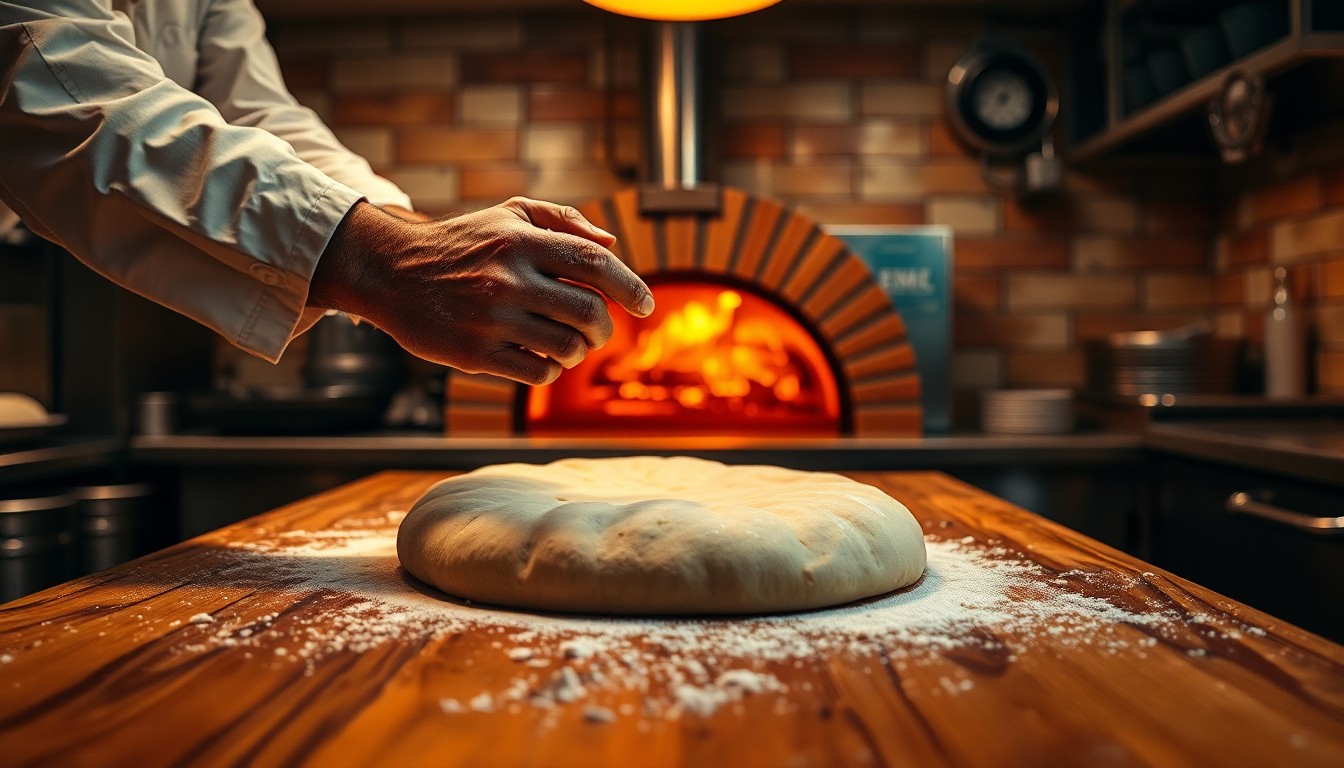
TLDR: A pizzaiolo is far more than someone who tosses dough for show. The role covers dough science, oven management, topping ratios, and kitchen timing — all calibrated to a specific style. The visuals in this article show exactly what that looks like at the dough table and in front of a 575°F deck oven at our Hanover location.
By Anthony Marino · Head Pizzaiolo, Brothers Pizza · Last updated May 20, 2026
I've been making NY-style pizza for 22 years. I learned from my uncle in a cramped Brooklyn kitchen where the oven was always on, the flour was always in the air, and the margin for error was basically zero. People ask me what I actually do all day. The honest answer: I manage variables that most customers never see.
This article walks through the full scope of what a pizzaiolo does — not the romanticized version, but the real one. We'll go through dough management, shaping, oven work, and the difference between a pizzaiolo who knows the craft and one who's just going through the motions.
Why You Can't Fully Understand This Job Without Seeing It
A recipe is a skeleton. The actual craft lives in what happens between the steps — the feel of dough that's properly fermented versus dough that's two hours short, the sound of a pie sliding onto a deck, the color of a crust at 90 seconds versus 3 minutes. That's why this article is built around visual references. Text describes; images prove.
If you've ever been to our York location during a Friday dinner rush — when we're moving through upward of 600 lbs of dough — you've seen this craft under pressure. It looks fast. It looks almost casual. It isn't.
Visual 1: The Dough Ball at Hour 72
**
**
A pizzaiolo's day starts here. Not at the oven. Not at the dough table. It starts 72 hours before service, when the dough goes into cold fermentation.
We use a cold-fermented dough process at all four Brothers Pizza locations. The cold retard slows yeast activity, which lets enzymes break down the flour's complex starches over time. The result is a crust with more flavor depth, better structure, and that characteristic chew you associate with real NY-style pizza — not the bready, dense crust you get from a same-day dough.
As shown in the image, look at annotation point B — those gas bubbles just beneath the surface skin. That's your proof that fermentation happened correctly. Under-proofed dough is smooth and tight, almost plasticky. Over-proofed dough is slack and sticky, with an irregular surface that tears instead of stretches. The dough in this photo is neither. It has tension in the skin (point A) while still being extensible enough to open by hand without a rolling pin.
The proofing tray (point C) matters more than people assume. Flour dusting isn't just to prevent sticking — it regulates the dough's outer moisture during the proof. Too little, and the skin tears when you open the ball. Too much, and you get raw flour on the bottom of the pie.
This is hour-zero work for a pizzaiolo. We prep dough so it's ready when service demands it, not when it's convenient.
Visual 2: Hand-Shaping vs. Rolling Pin
**
**
Compare this to Visual 1. Where the first image shows what the dough looks like before it's touched, this one shows what happens to its internal structure depending on how you shape it.
The left side is hand-shaped using what my uncle called the "knuckle push" — thumbs press the center down, knuckles stretch outward in a rotating motion. You're preserving the gas pockets built up during fermentation. The edge forms itself because you're pushing dough toward the perimeter, not compressing it. That uneven, organic rim (the cornicione) is the hallmark of a real NY-style pie.
The right side is what happens with a rolling pin. Flat, dense edge. The gas that spent 72 hours accumulating? Compressed out. The crust will bake up firmer and chewier in the wrong way — without the puff, without the char spots you want at the rim.
We never use a rolling pin at Brothers Pizza. Not on NY-style pies, not on our Sicilian slice base. The Sicilian gets pressed into an oiled pan by hand — a different technique, but still one that preserves structure.
A pizzaiolo who reaches for the rolling pin is either undertrained or working with dough that's already compromised. Nine times out of ten, it's the dough.
The Full Process: What Happens Between Cold Storage and Your Table
**
**
This is where the timing becomes critical. Each stage feeds the next. Skip or rush one, and you pay for it two steps later.
Cold storage → bench rest (Stage 1 & 2): Dough comes out of the 38°F cooler and sits at room temperature for 90 minutes minimum before shaping. Cold dough fights you. It springs back, tears, and never opens to a consistent thickness. We pull dough in waves timed to service — the 5pm wave, the 7pm rush, the late-night crowd that shows up after York Revolution games at PeoplesBank Park. Each wave gets its own pull-and-bench cycle.
Hand-shaping (Stage 3): As the process diagram shows, the hands move outward from center, rotating the skin. A 14-inch NY-style pie at Brothers Pizza ends up at roughly 1/4-inch thick in the center, thinner toward the middle, with a 3/4-inch cornicione. That takes about 90 seconds for an experienced pizzaiolo. New trainees average closer to 4 minutes and produce uneven thickness that bakes inconsistently.
Sauce application (Stage 4): We use a ladle in a circular motion starting from the center, leaving about an inch of rim bare. The sauce-to-cheese ratio is not a matter of taste — it's structural. Too much sauce creates steam under the cheese that breaks the melt pattern and softens the crust from the bottom up.
Cheese and toppings (Stage 5): Whole-milk low-moisture mozzarella, applied to cover the sauce without overlapping the rim. Toppings go on top of the cheese for most pies, underneath for our white pie — which has ricotta as its base and gets fresh mozzarella layered above the toppings instead of below.
Loading and baking (Stage 6): The pie goes onto a wooden peel dusted with semolina, then gets loaded onto the deck in one clean forward-and-back motion. Hesitate, and the dough sticks. Pull too fast, and the toppings shift. The deck oven at our Hanover store runs at 575°F. A standard 14-inch NY-style pie bakes in 7 to 9 minutes depending on topping load.
Comparison: Right Bake vs. Common Mistakes
**
**
The left example shows what we aim for every single pie. Spotted char on the cornicione — not uniform blackening, but leopard spots that come from the dough's natural sugars caramelizing against the deck. Cheese melted to a smooth, slightly browned surface with no pooling grease. The bottom of the crust should be firm enough to hold a fold without cracking.
The right side shows the two most common mistakes: pale and underbaked (oven too cool, dough pulled too early) or uniformly darkened with greasy cheese (oven temp uneven, or pie left too long without rotation).
A pizzaiolo rotates pies manually at the 4-minute mark. The back of the deck runs hotter than the front. If you don't turn the pie, the back burns before the front sets. This is one of those things you can't learn from a video. You learn it by ruining about 30 pies and then never forgetting it.
Detail Callout: The Cornicione — Most Misunderstood Part of NY-Style Pizza
**
**
The cornicione is where people who know pizza evaluate everything else. It tells you about the dough (fermentation time, hydration), the shaping (did the pizzaiolo preserve the gas structure), and the bake (did the oven have the right heat from the deck up through the dome).
Annotation point B is what most customers never see — the open crumb inside the rim. Those irregular holes are where the CO2 from 72 hours of fermentation lived. When the pie hits the 575°F deck, the dough springs up fast, the exterior sets before the interior can collapse, and you get a hollow-ish, airy rim. Compare that to a rolling-pin crust where point B would be nearly solid — compressed gluten with no air pockets, baking up dense and bready.
Point A — the char layer — gets mistaken for burnt crust. It isn't. Char at the cornicione is controlled Maillard reaction. It adds bitterness that balances the sweetness of the tomato sauce and the fat of the cheese. We actively manage for it. Customers who say "I don't want it burnt" are asking for a structurally correct but flavor-incomplete pie. We'll honor the request. But the char is there by design.
Point C — the transition zone — is where amateur pies fall apart. Too much sauce too close to the rim, and this zone gets soggy from steam. Too little dough thickness here, and the rim and the topped surface bake at different rates. Getting it right is a matter of repetition.
What Real-World Experience Looks Like at Brothers Pizza
I've personally trained more than 40 pizzaioli across our York, Gettysburg, Hanover, and McSherrystown locations. The training standard is the same at every store. Same dough formula. Same cold ferment time. Same deck temperature.
What varies is pace. A Friday night at our York location during a Delone Catholic basketball tournament is a different animal than a Tuesday lunch in McSherrystown. A pizzaiolo learns to read the board — the order queue — and pre-stage dough accordingly. You pull from the cooler based on projected volume, not on current volume. By the time a rush hits, your dough needs to already be at room temperature. If you're reacting to the rush, you're already behind.
The skills are also connected in ways that aren't obvious. Our history of NY-style pizza explains some of the regional context — why the flour, the water chemistry, and the oven type all intersect. Understanding that history makes you a better pizzaiolo, because you understand why the standards exist, not just what they are.
We're also a community kitchen. The families from York County and Adams County who come in for family pizza night are regulars. They know our product. When a pie comes out wrong — too pale, too thick, cornicione without char — they notice. That accountability is its own form of training.
Summary
Visual 1 showed what properly fermented dough looks like and why the 72-hour cold process creates visible, testable differences in texture and structure. Visual 2 demonstrated how hand-shaping versus rolling-pin shaping determines crust quality before the pie ever reaches the oven. The process diagram confirmed that a pizzaiolo's job is fundamentally about timing — from dough pull to deck load — with each stage setting up the next. The bake comparison showed how oven management and rotation separate a professional result from a common mistake. The cornicione close-up proved that the rim is a quality report on every decision made in the previous 72 hours.
That's what a pizzaiolo actually does. If you want to taste the result, find us at any of our four locations — York, Gettysburg, Hanover, or McSherrystown. The dough is already in the cooler for tonight's service.