
TLDR: New York-style pizza evolved from a single Neapolitan immigrant's coal-fired shop in 1905 into America's dominant pizza format—and the craft decisions made over 120 years are exactly why we make our dough the way we do at Brothers Pizza.
By Anthony Marino · Head Pizzaiolo, Brothers Pizza · Last updated May 20, 2026
Every Friday night at our York location, we go through roughly 600 lbs of dough. I've watched a lot of people eat that dough over 14 years running these kitchens, and I still believe most people don't know the story behind the slice they're holding. Not the mythology—the actual history, with real names, real places, and real craft decisions that still echo in every pizzeria in south-central Pennsylvania, including ours.
This article answers one question: how did New York-style pizza get here, and why does it taste the way it does?
The Context: What NY-Style Pizza Actually Is
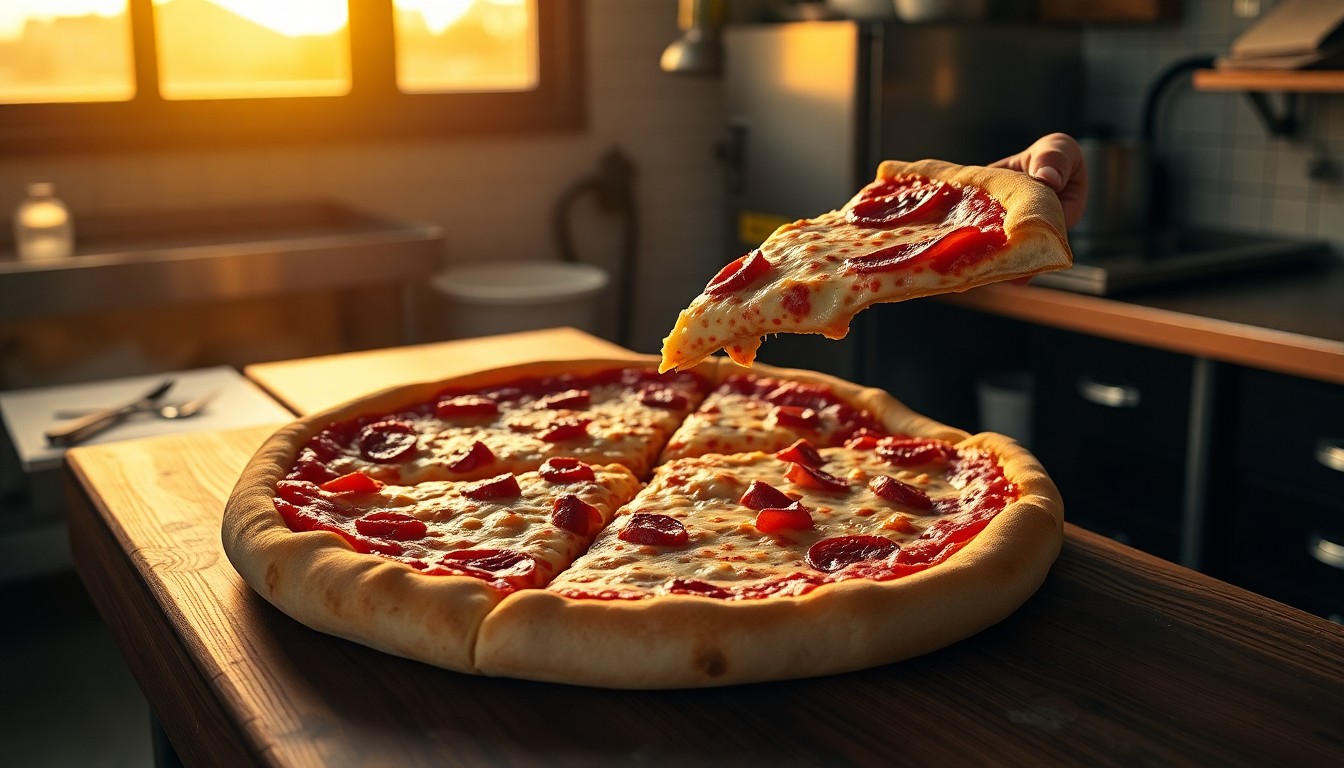
Before getting into the timeline, let's be precise about the style. New York-style pizza is a large, hand-tossed pie with a thin, foldable crust, a light layer of tomato sauce, low-moisture mozzarella, and enough structural integrity that you can fold it in half and eat it walking. The dough is high-gluten, typically fermented at least 24 hours (we go 72 hours cold-ferment at Brothers), and the bake happens fast—around 550–575°F in a deck oven.
That profile didn't appear fully formed. It was built piece by piece over more than a century.
The Decision: Gennaro Lombardi's Pivot, 1905
The story starts not with pizza but with bread. Gennaro Lombardi arrived from Naples in the 1890s and ran a grocery in Manhattan's Little Italy neighborhood at 53½ Spring Street. He sold tomato pies—essentially Neapolitan street food—wrapped in paper for workers to carry. By 1905, he formalized the operation as a sit-down pizzeria. American food historians widely recognize this as the first licensed pizzeria in the United States.
What Lombardi decided to keep from the Neapolitan original: the coal-fired oven (burning at 900°F+), San Marzano tomatoes, and fresh mozzarella. What New York quietly changed over the next two decades: the size of the pie grew dramatically (wood-fired Neapolitan pies ran 10–12 inches; New York pies pushed to 18 inches and beyond), and the cheese shifted toward low-moisture mozzarella as American dairy infrastructure couldn't keep fresh mozz consistent or affordable at scale.
That cheese swap is one of the most consequential decisions in American pizza history. Low-moisture mozzarella browns better, stretches farther, and holds up under the heat of a deck oven. It also changed the flavor profile permanently. If you've ever had a true Neapolitan Margherita and wondered why it tastes so different from a New York slice, the cheese is a big part of the answer.
The Process: How the Style Evolved, Decade by Decade
Week 1 (Circa 1905–1920): The Immigrant Kitchens
Lombardi's sparked a wave. Former employees—Anthony "Totonno" Pero in Coney Island (1924), John Sasso in New Haven (1925, technically a fork in the road toward New Haven style), Frank Pepe's operation—each took the core method and adapted it to local coal, local water, local flour. New York City's tap water became part of the mythology. The water is moderately hard, with mineral content that affects gluten development. Pizzaiolos who moved to other cities swore something was off. Some of that is real; some is nostalgia. Our water here in York County is different from Manhattan's, which is part of why we adjusted our dough hydration over years of testing.
Week 2 (1930s–1950s): Gas Ovens and the Slice Shop
Coal ovens are expensive to operate and harder to regulate. As gas infrastructure spread through New York in the 1930s and 40s, pizzerias converted. Gas deck ovens can't reach 900°F, so they run at 550–600°F. The crust thinned out. Bake times lengthened slightly (from under 2 minutes in coal to 7–10 minutes in gas). The result was a crispier bottom and a chewier, more bread-like rim—what pizza people call the cornicione.
The by-the-slice model exploded after World War II. Returning soldiers had developed a taste for Italian food in southern Italy and Sicily. The slice shop—walk in, point, hand over a quarter—became a New York institution. This format demanded a pie that held up at room temperature and reheated well under a broiler. Low-moisture mozz and the thinner, crispier base performed better than a soft Neapolitan pie would have.
Week 3 (1960s–1980s): The Diaspora
Here's where places like Brothers Pizza start to make sense historically. Italian-American families moved out of New York in massive numbers through the 1960s and 70s—to New Jersey, Philadelphia, and deeper into Pennsylvania. They brought their recipes, their technique, and their expectation of what a slice should be. York, Gettysburg, Hanover, McSherrystown—these towns had Italian-American families who knew pizza, who wanted it, and who eventually opened shops to serve it.
The style that landed in south-central PA was the late-1960s New York iteration: 18-inch pies, deck ovens, low-moisture mozz, hand-tossed dough with a 24-48 hour ferment. That's the DNA of what you're eating when you order a plain cheese slice from us at our Hanover location or pick up a white pie at York.
Week 4 (1990s–2010s): Craft and the Return to Fermentation
The 1990s were not kind to pizza quality nationally. Chain expansion, cost-cutting, pre-made dough balls shipped frozen—the craft eroded. What came back in the 2000s and 2010s was a renewed emphasis on fermentation. Longer cold ferments (48–72 hours) produce more complex flavor, better crust texture, and easier digestibility because the yeast and bacteria break down more of the gluten strands over time.
We moved to a 72-hour cold-ferment at Brothers about eight years ago. It's not faster or cheaper—it requires more planning, more refrigeration space, more dough math on a Tuesday to make sure Friday's rush is covered. But the difference in crust flavor is not subtle. A 24-hour dough tastes like bread with toppings. A 72-hour dough has acidity, complexity, and a chew that doesn't fight you.
The Numbers: What the Timeline Produced
| Era | Oven Type | Temp | Ferment Time | Crust Profile |
|---|---|---|---|---|
| 1905–1930s | Coal-fired | 850–950°F | 12–24 hrs | Thin, charred, soft center |
| 1940s–1960s | Gas deck | 550–600°F | 24 hrs | Crispy bottom, chewy rim |
| 1970s–1990s | Gas deck | 525–575°F | 12–24 hrs | Consistent, mass-market |
| 2000s–present | Gas deck | 550–575°F | 48–72 hrs | Craft revival, complex flavor |
The deck oven at our Hanover store runs at 565°F. The one in McSherrystown runs at 570°F because the oven is slightly newer and holds heat differently. I check both calibrations monthly. These aren't abstract numbers—a 25-degree variance changes the bottom color and crust crunch in ways a trained eye spots immediately.
What Went Wrong: The Mistakes Along the Way
Pizza history is also a history of shortcuts that damaged the craft.
The frozen dough era (1980s–1990s): Large suppliers sold pizzerias pre-portioned, pre-balled frozen dough. It was convenient and consistent in the worst way—consistently mediocre. The fermentation flavor was gone. The crust was uniform and forgettable. A lot of regional pizzerias lost their identity this way.
Over-saucing as a regional adaptation: When NY-style moved inland, some shops started piling on sauce to compensate for bland dough. It became a mask. We learned early on that the sauce—crushed San Marzano-style tomatoes, salt, a little dried oregano, nothing cooked—should enhance a crust you're proud of, not cover one you're not.
The mozzarella shortcut: Whole-milk low-moisture mozz is not the same as part-skim. Part-skim melts differently, browns faster, and can turn rubbery. We use whole-milk exclusively. Costs more per pie. Non-negotiable.
What Worked: The Three Things That Kept NY-Style Alive
1. The fold test. A properly made NY slice holds its shape when you hold the crust end and lets the tip fold down naturally under gravity. If it droops completely (too much moisture, underbaked) or snaps (over-baked, too thin), something went wrong. This simple physical test has been the quality control mechanism in NY pizza kitchens for decades—and it still is in ours.
2. High-gluten flour. New York pizzerias standardized on high-gluten bread flour (14%+ protein) because it develops the gluten network needed for both the toss and the chew. All-purpose flour makes decent bread. High-gluten flour makes NY-style pizza. We source 50-lb bags of high-gluten flour and go through about 1,200 lbs in a busy week across all four locations.
3. The deck oven's stone. The deck oven's ceramic or cordierite stone surface transfers heat directly to the bottom of the dough, creating the crispy undercarriage that separates a NY slice from a pan-baked pie. There's no shortcut for this. You can read about calzone vs. stromboli and see that the same dough behaves completely differently depending on how it meets heat.
What Real Kitchen Experience Tells You
I learned dough from my uncle in Brooklyn. He made everything by feel—hydration, salt, proofing time—and he was right almost every time. I spent years translating that feel into repeatable numbers so I could teach it to 40-plus pizzaiolos across our four locations.
Here's the counter-intuitive thing experience taught me: a colder dough makes a better pizza. Most people assume heat speeds up fermentation and flavor development. It does—but too fast means too little complexity. The slow, cold fermentation we use (38°F, 72 hours) builds flavor compounds that a room-temperature 4-hour ferment simply cannot replicate. When I train a new pizzaiolo at our York location, that's the first thing I explain. Patience is the ingredient.
The other thing experience tells you: New York-style pizza is a living style, not a fixed recipe. The pizzaiolos who kept it honest were the ones who understood why each decision was made, not just how to execute it. When you understand that low-moisture mozz came out of economic necessity and dairy infrastructure, you can make smarter choices about when to upgrade (special menu items with fresh mozz on a white pie) and when to stay with the standard (your everyday slice).
If you're looking for ideas on how to build a night around this food, our family pizza night ideas for York families page has some practical suggestions—but the history is what makes the meal mean something.
What I'd Do Differently
If I were teaching the history of NY-style pizza from the beginning again, I'd start with the fermentation science before the narrative. Most new pizzaiolos memorize the story (Lombardi, Totonno, Di Fara) without understanding the yeast biology that makes the crust work. The history matters because it explains the craft decisions. The craft decisions are what you're executing every day.
I'd also visit a coal-fired oven earlier in my career. I've cooked in one twice. It changes your understanding of heat and char permanently. The NY-style deck oven is a compromise—a very good one—but knowing what you're compromising from sharpens your awareness of what the oven can and can't do.
Key Takeaways
NY-style pizza is a chain of specific craft decisions, not a single invention. Each decade added or subtracted something—coal to gas, fresh mozz to low-moisture, 12-hour ferment to 72-hour. Understanding the why behind each decision makes you a better cook and a more informed eater.
The 72-hour cold ferment is not optional if you want complexity. We moved to it eight years ago at Brothers and it changed our crust in a way customers noticed without us telling them. The feedback was immediate.
High-gluten flour and a stone deck are structural requirements, not preferences. You can make a tasty pizza without them. You cannot make authentic NY-style pizza without them.
The fold test is your QC. If the slice can't fold, something is wrong. Fix the dough or fix the bake, but don't serve it.
Regional adaptation is legitimate—but know what you're adapting. Our dough in York and McSherrystown is calibrated to our water, our ovens, our fermentation environment. That's not cheating the NY tradition. That's exactly what the tradition has always done.
Come see the dough in action. Visit us in York, check our full menu at /our-food.html, or find us in McSherrystown and Gettysburg. We make the dough fresh every day—and now you know exactly what that means.