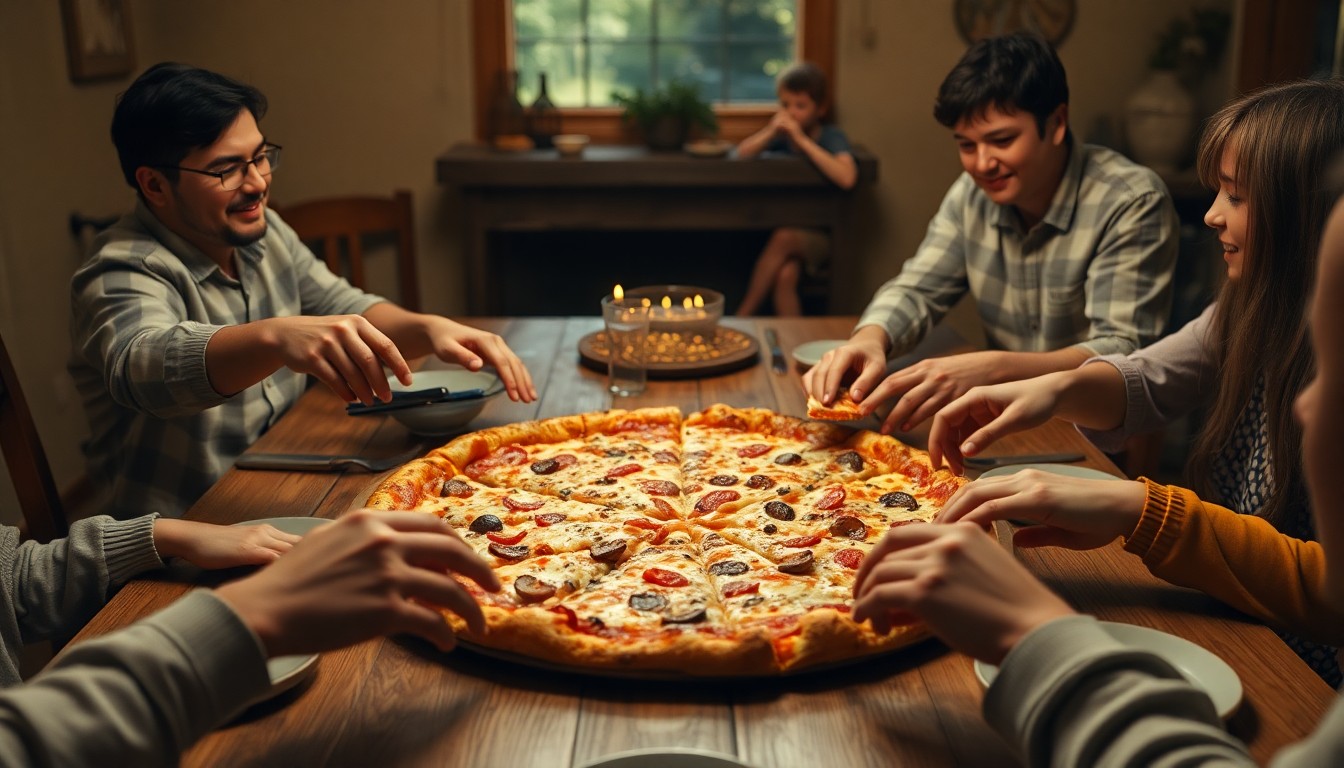
TLDR: A great family pizza night in York comes down to three things—the right dough, a build-your-own topping setup that keeps everyone happy, and knowing when to make it at home versus when to call Brothers Pizza. The visuals below show exactly how we set up topping stations and how a finished Friday night table looks at our York location.
By Anthony Marino · Head Pizzaiolo, Brothers Pizza · Last updated May 19, 2026
We go through about 600 lbs of dough on a Friday night across all four of our locations. A big chunk of that is families—parents dragging in two kids in soccer cleats, grandparents who've been coming since the '90s, groups from Northeastern High or York Suburban who just finished a game. Family pizza night is the most normal thing in York County, and we've watched thousands of them happen up close.
This article answers the question most families actually have: how do you make pizza night feel special without it becoming a project? Whether you're eating in, ordering out, or trying to get the kids involved at home, here's what actually works.
Why Pizza Night Needs a Visual Game Plan
Pizza night fails when it's unstructured. Two kids want cheese only. One parent wants white pie. Someone is gluten-sensitive this week. Without a plan you end up with four separate orders and no shared moment.
The fix is visual—a physical setup, a topping bar, a table layout—that turns pizza from a transaction into an activity. When people can see their options, they engage. That's true whether you're setting up a counter at home or sitting down at our York location.
The sections below are organized around visual setups you can actually replicate.
Visual 1: The Build-Your-Own Topping Station
The setup in this photo does something simple but important: it makes every topping a visual object, not a spoken negotiation. When a seven-year-old can point to the pepperoni bowl, she's not fighting with her brother about what goes on which slice—she's picking her half.
At home, use small ramekins or muffin tins. Set them out before the pizza arrives (or before you stretch the dough, if you're making it yourself). The sequence matters: sauce options first, cheese second, proteins third, vegetables fourth, finishing touches like fresh basil and chili flakes last. That order mirrors how pizza is actually built, which subtly teaches kids the logic of the thing.
For the sauce, keep it to two options maximum. Our house marinara is a cooked, slightly sweet San Marzano-style sauce. The second option we'd suggest at home is a simple garlic-and-olive-oil base—same thing we use on our white pie. Two sauces gives variety without chaos.
Visual 2: The Finished Friday Night Table
Compare this to Visual 1. The topping station is about process—what happens before the pizza. This table is about composition—what you actually order or serve.
Notice the Stromboli on the cutting board. That's intentional. Not every family member wants a full slice, especially younger kids or people who ate a bigger lunch. A Stromboli—folded dough with fillings baked in—gives you something handheld and portion-flexible. We've written a breakdown of the calzone vs. stromboli question if your family debates that distinction (they're different, and the distinction matters).
The mix of a red pie and a white pie on the same table is something we recommend constantly. You almost always have one person who is tomato-sensitive or who just prefers the richness of a white. Having both eliminates the "I'll just pick the toppings off" compromise.
The Process: Running a Pizza Night That Actually Works
Walk through each stage:
Stage 1 — Prep the dough together. If you're making pizza at home, get the dough out of the fridge 60–90 minutes before you need it. Cold dough fights you. We use a 72-hour cold-fermented dough at all four Brothers Pizza locations—that long cold rest builds the flavor you can't fake with same-day dough. At home, most grocery store dough balls are same-day, so let them warm up fully and add a pinch more salt than you think you need. Letting kids press the dough into a sheet pan (not a round—easier for beginners) gives them ownership over the result.
Stage 2 — Use the topping station. As shown in Visual 1, the station should already be set before you open the dough. Sauce goes on first, spread with the back of a spoon in a circular motion leaving a half-inch border. Then cheese. Then toppings. Resist the urge to pile—NY-style is a thin, structural crust and it can't support a mountain of toppings without going limp in the center.
Stage 3 — Slice and serve at the table. A pizza wheel works, but a large chef's knife gives you cleaner slices because you're pressing straight down instead of rolling through the crust. Slice the pizza at the table if you can. It's a small theatrical moment that kids remember. Cut large pies into 8 slices, smaller 10-inch rounds into 6.
Stage 4 — Eat before it cools. NY-style pizza is designed to be eaten in the first five minutes. The cheese is still slightly molten, the crust has a crunch that disappears fast. If you've ordered from our York location or McSherrystown, open the box the second it hits your table.
Comparison: A Pizza Night That Lands vs. One That Doesn't
The left example in this comparison shows what we'd call a decided pizza night—choices were made before the food arrived, the table was set for the format of the meal, and the mix of pies matches the group's actual preferences.
The right shows the most common mistake: decision fatigue baked into the process itself. The pizza arrives and nobody has agreed on anything. The single pie gets overloaded. Nobody is happy with the result, and the leftover slices don't reheat well because the toppings have steamed the crust soggy.
The practical fix: make one decision before you order. "We're doing two larges—one classic red with pepperoni, one white pie." Done. Everything else is negotiable, but that anchor decision keeps the night from unraveling.
If you're eating out and bringing kids, sit in a booth. It contains them physically and turns the table into its own little world. Our York location has booths along the wall that work perfectly for this.
Detail Callout: The One Thing Families Consistently Get Wrong
This is the most misunderstood part of NY-style pizza, and it matters for family pizza night because it determines whether you pick up or make at home.
The bottom of a proper NY-style slice—baked directly on the deck of a 550–575°F oven—has a structural crispness that a home oven at 425°F simply cannot replicate. The deck oven at our Hanover store runs at 575°F. Our York location runs the same. That direct stone contact is what creates the charred, cracker-like bottom that lets you fold a large slice without it drooping.
When you make pizza at home, the best you can do is use a preheated pizza stone or steel on the bottom rack and crank your oven as high as it will go (usually 500–525°F). It's better than a cold pan, but it's still not a commercial deck oven. That's not a criticism—it's just physics.
For family pizza night, that difference is worth knowing. If half the point is a great slice, order from us. If half the point is the activity of making it together, bake it at home and accept that the crust will be slightly softer. Both are valid. They're just different nights.
You can read more about the crust and style differences in our breakdown of NY-style vs. Neapolitan vs. Detroit pizza—it gives you the full context on why each style has its own identity.
Real-World Experience: What 14 Years of Friday Nights Teaches You
I've watched families come through our York and McSherrystown locations every Friday for years. Here's what separates the good pizza nights from the forgettable ones.
The families who do it well arrive knowing their order. They've had the conversation in the car. Two larges, maybe a Sicilian slice for the one kid who won't eat anything else, a side of garlic knots. That family sits down relaxed, the kids get their food faster, and everyone leaves full and happy.
The families who struggle arrive still deciding. One parent is on the menu app, one is asking kids who change their minds every thirty seconds, and the window of "everyone is hungry but nobody is miserable yet" closes before they've ordered.
This is not a criticism. We've all had that night. It's just to say: the single biggest upgrade to family pizza night isn't the pizza—it's the ten minutes of planning before you leave the house.
A few other things I've learned from training over 40 pizzaioli and watching thousands of family tables:
- Let kids pick one topping each. Not the whole pizza—one topping. It gives them agency without giving them control.
- Order more than you think you need. Cold pizza for Saturday breakfast is not a consolation prize. It's a feature. Our Sicilian slices reheat exceptionally well—the thick crust holds up in a 375°F oven for 8 minutes.
- Don't skip the Stromboli. Even if everyone likes pizza, having one folded item on the table changes the dynamic. It's a conversation piece.
Common Mistakes and How to Avoid Them
Ordering too late on a Friday. Our peak window is 5:30–7:30 PM on Fridays. If you want your pizza hot and fast, call before 5 PM or order online with a scheduled pickup time. This applies across York, Hanover, Gettysburg, and McSherrystown.
Skipping the crust type conversation. If someone at your table is used to thick pan pizza and you order NY-style, they may be surprised. Our NY-style vs. Neapolitan vs. Detroit page lays out the differences clearly. Manage expectations before the pizza arrives.
Using cold dough at home. If you're making your own, cold dough is the number one reason home pizza fails. Room temperature, fully relaxed dough stretches without tearing and bakes evenly. Budget the time.
Forgetting napkins. NY-style pizza, eaten properly (folded), releases grease at the fold. You need napkins. This is not optional.
Summary
Visual 1 showed you a topping station—the setup that turns pizza night into a participatory event rather than a delivery transaction. Visual 2 showed the finished table and established why a mix of pie styles (plus a Stromboli) serves a family better than a single overloaded order. The process diagram confirmed that pizza night has four distinct stages, and the first two happen before the food arrives. The comparison showed that decision fatigue is the most common enemy of a good pizza night. The detail callout explained why deck-oven crust matters and helped you decide when to bake at home versus when to order.
Family pizza night in York doesn't need to be complicated. It just needs to be decided. Check out our full menu at our food page, or stop into whichever Brothers Pizza location is closest to you—York or McSherrystown are both open seven days a week.